
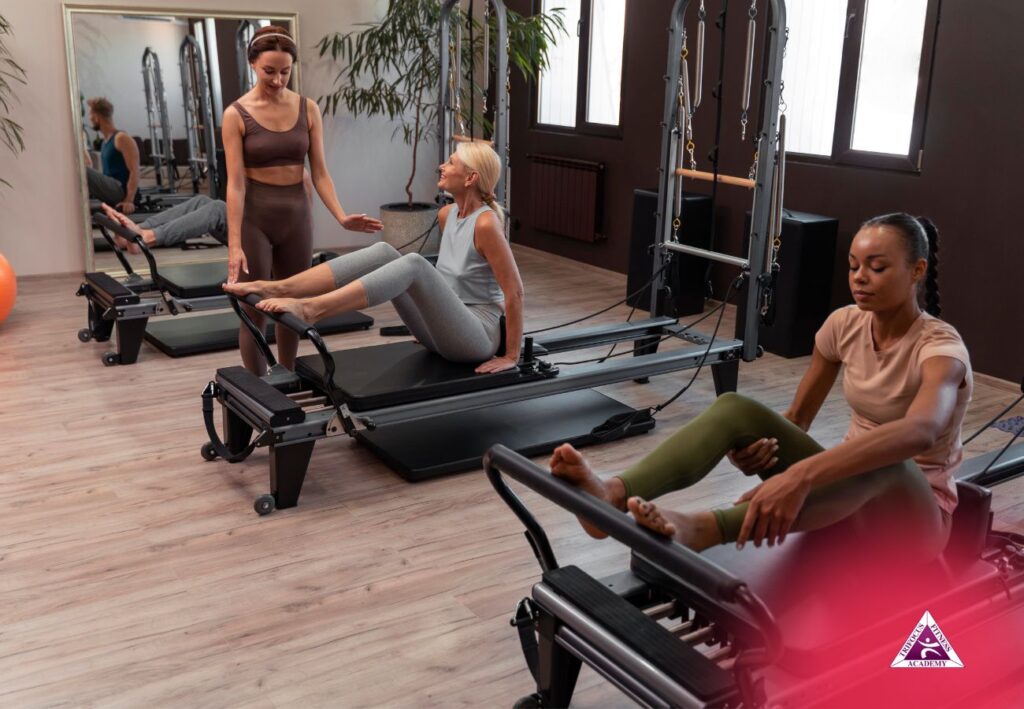
When someone hears endurance training, they most likely think of gruelling cardio, heavy lifting and high-impact exercises that are hard on the joints and muscles. But high-impact workouts are not the best fit for everyone. Suppose you are looking for an easier way to build your stamina and strength. In that case, Pilates exercises can be the best choice for you, using controlled movements, breathing, and centring to condition muscles with long-term endurance and flexibility in mind, while also developing control of the body without repetitive stress from running or jumping.
In Pilates, this is accomplished by activating deep stabilising muscles continuously while working in a range of exercises. High-impact workouts are focused on explosive movements and external resistance, whereas Pilates works inwardly to develop strength. In other words, this is perfect for those who are unable to practice high-intensity workouts (e.g., individuals who have injured a body part and are looking forward to physical therapy, individuals with joint sensitivity) and for those who want an all-around fitness approach combining strength training, flexibility and muscular endurance.
Enhancing Muscular Endurance Through Targeted Pilates Exercises
Pilates routines are targeted at endurance and use the stabilising muscles of the body, particularly those in the core (trunk and abdomen), back, hip complex and shoulder region. Unlike high-intensity workouts that focus on explosive power and heavy lifting, Pilates focuses on slow, controlled movements where muscles work through muscle contraction for an extended period. This constant firing keeps muscle in a state of contraction for extended periods and is therefore beneficial for muscular endurance.
Every Pilates exercise is a challenge for the body to control movement with precision. Exercises like leg circles, plank variations and the Pilates hundred require long-duration core contraction, training these muscles to stabilise and hold themselves up without adding assistance from momentum. Pilates exercises, which isolate muscles and promote isometric holds, create endurance not through impact or external load but through time-under-tension.
In addition to it, Pilates principles stress the importance of muscular symmetry. Many traditional workouts use the strongest muscles instead of the most inefficient/weak component (functional trainer term), which occurs in all sports that lead to fatigue and imbalance. Pilates fixes this by including all assisting muscles proportionally, which in turn leads to improved posture and endurance over the long term. This emphasis on the entire body in Pilates movements forces muscles to work together and cultivate stamina in a functional and seated way.
Regular practice of Pilates exercises trains the body to remain strong and under control when doing strenuous physical activities for longer durations. Suppose you perform this low-impact routine effectively and adequately build the muscular endurance required to complete tasks in your daily life, as well as highly intensive athletic pursuits. In that case, it’s safe to say you do not need high-intensity impact to work up a sweat.
The Role of Breath Control in Sustaining Stamina During Pilates Exercises
Pilates are of particular importance in terms of breath control and endurance. Whereas many other forms of exercise put less emphasis on breath, Pilates pairs coordinated breath with movement, can increase oxygen flow, provide stamina, prevent energy leaks and prolong muscle activation. This principle not only assists in physical performance but also encourages mental concentration and increases endurance.
Throughout Pilates workouts, people are instructed to take a deep breath via the nose and exhale fully through their mouths, coordinating every inhaling pattern with each movement. The technique of deep diaphragmatic breathing helps to metabolise oxygen, aiding the muscles while staving off fatigue. Breath control supports endurance by providing a constant flow of oxygen to muscles in use, which helps people hold their effort over longer Pilates sessions.
Breath control also helps with core engagement. Breathing out on the effort also activates the deep abdominals, giving you more core stability and strength. Working together the whole time helps maintain muscle integrity and prevent unwanted energy leaks that might otherwise be caused by inefficient muscular function.
In addition, it helps in balancing the nervous system with controlled breathing. To keep the practitioner calm and focused, to avoid unnecessary tension and to save energy. This is especially helpful in those complex Pilates movements that require a significant amount of focus and accuracy.
Joint-Friendly Strength Development Through Low-Impact Pilates Exercises
Pilates have a significant focus on being joint-friendly to develop strength and stamina. Although they are effective for some, high-impact workouts place added stress on joints, ligaments and tendons that can lead to wear and tear over time as well. In Pilates, you get strength with controlled and low-impact movements, which means less wear & tear on the body’s connective tissues.
Hence, mat Pilates are all about alignment and precision, so that you can move through the functional range of motion. This takes the strain off the joints without losing a great weight workout that also builds stamina and strength. The spine is the foundation of movement and connects to the ground at the base (pelvis), where many stabilising muscles ensure bone integrity around its respective joints. Exercises such as bridges, single leg lifts and seated rotations create balanced stability for the pelvic region, promoting good mobility within its 3-D sphere of motion without collapsing into rotation or excessive extension.
In addition to the glutes, Pilates works the small stabilising muscles that surround joints, which are usually unable to be attacked effectively by weights. For example, hip stability exercises, which develop the gluteus Medius, or rotator cuff exercises for shoulder health. By improving the strength of these stabilisers, you would end up requiring less help from the bigger muscles to perform movements, resulting in longer endurance and more distributed work across your body.
Gear like Pilates reformers, resistance bands, and little stability balls can also boost people-friendly strength growth. They provide some gentle resistance that avoids the need for heavy weights or impact, so people can progressively build endurance and strength.
Consistency in Pilates Exercises: The Key to Long-Term Endurance Gains
Endurance is something which cannot be grown in a day but can only be built through regular practice and gradual increments. Consistency in endurance training is conducive to the effectiveness of Pilates exercises through a highly sustainable and adaptable workout routine backed up by long-term endurance gains. This is a complete 180 compared to schools of thought that promote high-impact routines, which can quickly lead to burnout or injury. Pilates asks that you pay attention while moving your body, making it more sustainable.
Pilates are versatile. Another reason why Pilates exercise promotes consistency is that they are varied. This means the workouts can be tailored for those who are new to exercise, right through to experienced exercisers. While exercises can be modified to be challenging by using body weight, small props and Pilates equipment, this will ensure that participants are constantly improving without working too hard.
Top-tier life demands ours in a way that precludes adhering to a regimented workout schedule. Again, another point to highlight on why Pilates is such a great form of exercise is that the flexibility of doing your workouts either at home, in studios, or even during short breaks makes it much easier for you to stay consistent. If you do Pilates daily, or 4-5 days a week, then short and focused Pilates sessions can certainly help build stamina as if longer workouts were performed regularly.
Regular Pilates practice also deepens the mind-body connection that develops in every class. As people become more sensitive to the motions, alignment and breath system of the body, the durability is naturally increased. This approach leads to many people sticking with Pilates as a long-term practice because it is an inside-out process based on authentic motivation.
Conclusion
Endurance sounds like hours of sweat-inducing workouts and pounding your joints into oblivion, right? Well, not so much with Pilates exercises as it is more about a glistening sheen and learning you don’t have to pound your body to have lasting power. Pilates exercises develop muscular endurance using controlled movement, breath coordination, and brain engagement of stabilising muscles.
Pilates works to increase muscular endurance by focusing on those deep muscle groups with practical, low-impact efforts. Through the incorporation of breathwork, participants receive a consistent oxygen flow that will not only increase physical endurance but also keep their minds focused during workouts. In addition, Pilates movements also promote more stable body joints and muscles, which help prevent injury and achieve the desired result of long-term functional power.
Contact Trifocus Fitness Academy
Explore the rewarding path of becoming a certified Pilates Instructor. Unleash your potential and inspire others on your journey with Trifocus Fitness Academy’s comprehensive Pilates Instructor program.

Frequently Asked Questions
Yes, that is because the Pilates exercises work by building endurance, wherein you are working on both holding contractions and regular movement patterns, while being aware of your breath pattern. Unlike the monotonous jumping or leaping of high-impact cardio, dynamic overloading of heavy lifting, Pilates works on lengthening unique deep muscle groups and improving endurance through detailed control. Pilates requires you to spend time under tension, and it helps you to control your muscles, which is how Pilates increases muscle endurance in a way that is easy on your joints with its low-impact exercise.
Builds Muscular endurance. Pilates exercises are performed using slow, precise movements that work muscles continuously over time. Workouts for fat-burning include exercises such as planks, bridges, and leg lifts, which require a constant activation of core and stabilising muscles that train them to work overtime. This TUT approach, while increasing endurance without the need for heavy weights or fast-paced reps, Pilates helps to target all muscle groups equally, which means you won’t tire out as quickly from relying on dominant muscle groups.
A fundamental component of Pilates exercises is also directly related to endurance. Through the coordination of deep, diaphragmatic breathing with movement, Pilates increases oxygen delivery to working muscles, assisting in buffering fatigue and sustaining energy levels over workouts. In addition, proper breath control also engages the core muscles, which can further stabilise and enhance strength during exercise. Also, when you are calm & focused, brain energy is spared (rather than wasted), giving better performance.
Absolutely. Pilates exercises are created with joint safety in mind by promoting alignment, movement control and muscle balance. Rather than perform movements that put excessive strain on the joints due to repetitive loading or heavy loads, Pilates uses these muscles to support a stable joint, which in turn would reduce strain on ligaments and tendons. Movements are done in a smaller, safer range of motion that targets the primary stabilising muscles, which is perfect for many people who have joint pain and arthritis or are recovering from an injury.
Pilates, and its practice in a regular rhythm over time, gives you long-term strength that will stick with you. If you practice Pilates exercises regularly, you will eventually remember the movements more easily and be able to concentrate on your form. Being beginners and returning to exercise, we can get injured in our regular routines of most physical activity; this is why Pilates is great as it is adaptive and low-impact. Making it a part of our routine is what trains the same muscles to withstand work and increases overall stamina somewhat gradually over time.
Pilates is an appropriate type of exercise for people of all ages and fitness levels who wish to develop endurance without high-impact stress. Yes, that is right–beginners, senior citizens, injured people or even athletes looking for a holistic approach to strength and endurance. For those with joint sensitivities, chronic pain, or seeking a mindful, low-impact approach to fitness, you should do Pilates. With its focus on controlled movement, breathwork, and core stability, Pilates allows participants to build endurance safely in a full-body style that is sustainable long-term.