
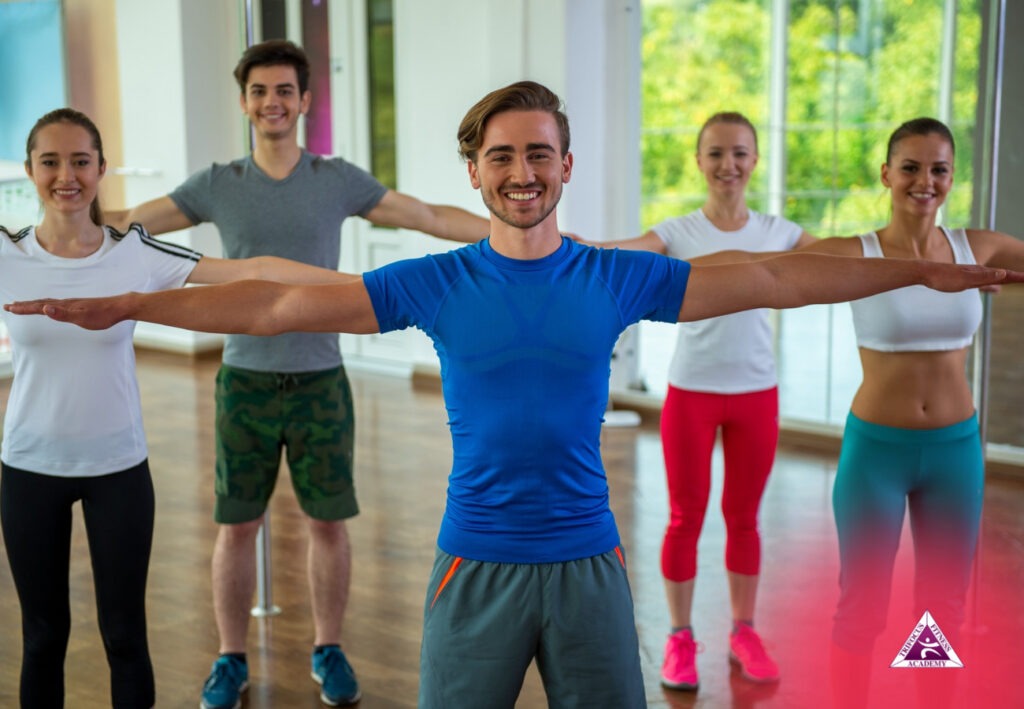
Teaching group exercise effectively requires more than demonstrating movements and motivating participants. Instructors should also have practical knowledge of body mechanics to clearly demonstrate exercises, identify potentially inappropriate movement patterns, offer appropriate modifications, and design classes based on participants’ abilities. Body mechanics refers to how the body moves and uses muscles, joints, bones, and connective tissue to accomplish movement.
When performing movements like squatting, lunging, lifting, jumping, cycling, or floor exercise, factors like posture, joint alignment, balance, range of motion, speed, and resistance affect how the movement is performed. A Group Exercise instructor must know these principles because students have varying fitness levels, movement experience, mobility, and physical ability. What suits one person may need to be modified for another.
Understand Alignment, Joint Position and Movement Control
The first step to good body mechanics is understanding how body parts function in relation to each other during movement. In group exercise, the instructor should be able to check basic alignment and understand that it won’t look the same for everyone because anatomy varies naturally. For instance, when performing a squat, the instructor might observe how the feet, knees, hips, torso, and spine move in relation to each other, rather than just the feet. In an upper-body exercise, shoulder position, trunk stability, hand type, and movement control can all affect the ease and effectiveness of the exercise.
Posture observations may also be helpful. When assessing posture, ACE assessment resources help you observe foot and ankle position, knee alignment, hip movement, spinal position, shoulders, and head position. But don’t mistake a group class observation for a medical assessment or diagnosis. Similarly, movement control is needed. When performing exercises, speed and/or momentum can make them more difficult to control, especially with added resistance. ACSM guidelines for resistance training emphasise controlled movement, proper posture, and optimal ranges of motion.
Teachers and trainers should therefore model the movement at a pace participants can keep up with and use clear cues to direct attention to key actions. Cues don’t have to be complicated or technical; they can be simple and practical. Remind participants to keep their stance comfortable, control the motion, keep the load within their capacity, and work within a range they can do well. Knowledge of mechanics helps teachers recognise when technique is becoming less controlled and when slowing speed, resistance, impact, or range is indicated.
Provide Progressions and Modifications for Different Participants
Group Exercise classes often include participants with varying experience. One person may have been training for years; another may be attending their first structured exercise session. Safe teaching, however, cannot be achieved by showing only one form of each movement. Progressions and modifications enable participants to work at an appropriate level. A jumping movement can also be shown as a less strenuous stepping movement. A deep lunge can be done with a smaller range of motion, and a resistance exercise can be done with a lighter load or without weight.
The ACSM also identifies demonstrating exercise progressions, making modifications, correcting improper technique, and monitoring exercise intensity as key skills for group exercise instructors. Modifications should not be offered as less than the original exercise. Instructors select them based on experience, fatigue, mobility, preference, recovery status, or the requirements of a specific session. When discussing multiple options, normalisation can help create a more inclusive, safer classroom environment. Intensity should also increase at an appropriate rate.
There are public health guidelines for progressive increases in activity, as sudden increases (over time) in workload can increase the risk of musculoskeletal issues, especially for those who are not conditioned. Teachers can give participants opportunities to build confidence and improve movement quality before increasing speed, resistance, complexity, or impact. Importantly, teachers should not overstep boundaries. If pain persists, joints are very sore, or there are concerning symptoms such as persistent pain, significant joint discomfort, dizziness, or unusual shortness of breath, unsystematic exercise is not the right diagnosis or “correction”. The participant may need to stop and seek proper medical advice.
Use Clear Cueing and Observation to Support Safer Movement
An instructor may deeply understand excellent exercise technique but not be able to teach it if the cues aren’t clear. Safe Group Exercise instruction therefore depends heavily on communication. ACSM identifies anticipatory, Directional, Educational, Motivational, Safety, and Visual cues as communication skills that apply to group instruction. Effective cueing helps participants understand what movement they are about to make, where their body will move, and which part of the movement to focus on. Timing is crucial. It’s not very useful to give a cue after everyone has finished a movement. Instructors must inform participants about any changes as soon as possible.
Demonstration also matters. If participants copy what they see, the instructor should show the form they want the class to use. When multiple choices are available, try to explain the simple version of the movement first, then discuss the progressions. Observation should follow the start of class. Teachers must watch participants’ performance for decreasing movement control, fatigue, lack of follow-through, or excessive fatigue.
Keep corrective feedback brief and tactful. Provide general cues for common problems throughout the class, and individual cues if a participant needs more assistance. Group Exercise instructors should also keep in mind that the more complex the cue, the more complex the exercise. Excessive instructions may reduce participants’ self-confidence. Good, timely communication helps participants focus on key movement priorities and keeps participation and safety at the centre of the entire system.
Manage Load, Fatigue and Class Design with Body Mechanics in Mind
Body mechanics may change as participants become fatigued. A Movement that is easy to perform early in a Group Exercise session can be harder later if muscle fatigue sets in, concentration wanes, or exercise intensity increases. The design of a class should therefore account for the demands on participants over time. Repeating many high-impact/high-load movements in the same way or at the same intensity can cause unnecessary fatigue, especially for inexperienced participants.
Warm-ups can ease the body into more strenuous activity. Current physical activity guidelines recommend gradually increasing heart rate and breathing rate before more moderate or vigorous aerobic exercise, and lighter activity before beginning muscle-strengthening activity. Exercise sequencing should also be mechanically appropriate. More complex movements may be easier to learn before participants are very tired, and resistance and intensity should not be too much for participants to handle.
There’s another thought: equipment. Equipment, such as steps, resistance bands, dumbbells, bikes, mats, and other items, should be placed and used appropriately for its intended purpose. Space between participants also helps minimise unnecessary movement restrictions and conflicts. Students should follow their teacher’s guidance to adjust their technique as intensity changes. If a participant cannot maintain control of an exercise, it may be more appropriate to decrease resistance, range, speed, or impact rather than continue challenging them at their current level.
Conclusion
The basics of good Group Exercise teaching include knowledge and awareness of body mechanics. Instructors have to teach participants who are very different from one another, some strong, some weak; some mobile, some not; some experienced, some not; some coordinated, some not; some fit, some not—which requires them to adjust the way they teach, rather than expecting everyone to perform the exercises the same way.
Understanding alignment, joint movement, posture, range of motion, and movement control helps instructors demonstrate exercises more effectively and identify when a participant might need a different exercise. Instructors should also consider progressions and modifications. Adjust impact, range, resistance, speed, or complexity so participants can choose a suitable level while staying engaged in class.
Contact the Trifocus Fitness Academy
The Trifocus Fitness Academy offers specialised online and internationally accredited Group Exercise courses that have been designed to outfit professionals with all of the skills and knowledge needed to find success as a professional Group Exercise Specialist.

Frequently Asked Questions
Body mechanics helps Group Exercise instructors understand how the body aligns, how joints move, and how posture, balance, and control work. This understanding clarifies exercise demonstrations, creates a safer exercise environment, and supports effective modifications for individuals with varying abilities.
Modifications let players adjust range of motion, resistance, impact, or difficulty based on their experience, mobility, fitness, and comfort. They make classes more inclusive while not demeaning other movements.
Group Exercise instructors can enhance safety by providing clear demonstrations, timing cues, selecting appropriate progressions, adjusting intensity, observing participants, and decreasing speed, resistance, and range when movement control begins to decrease.
Fatigue may impair coordination, concentration and movement control. As the class moves forward, the instructor should monitor each exercise’s difficulty and adjust it as needed if technique begins to break down.
Group exercise instructors should not diagnose or treat pain. If the discomfort is unusual or severe, or if symptoms persist for an extended period of time, the participant may need to stop and seek medical advice.
Clear cueing helps participants understand what to expect in upcoming movements, body positioning, direction, and technique. Clear instructions, given at the right time, minimise confusion and help participants move with more control and confidence.