
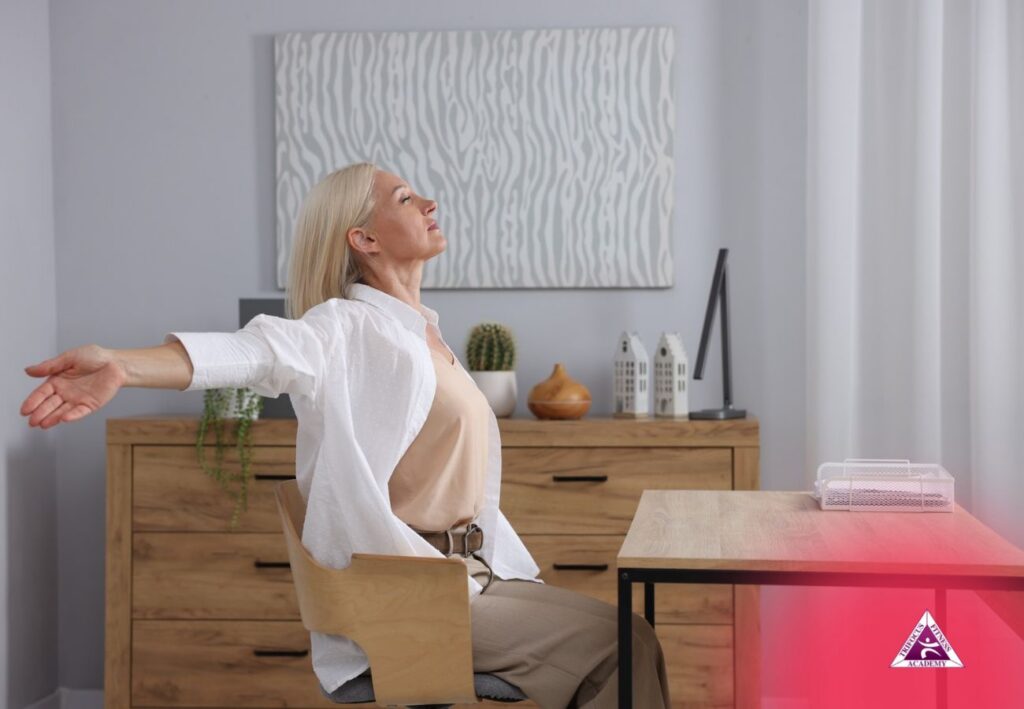
When standing or floor exercises, or more challenging exercises, aren’t suitable, chair exercises can help improve mobility and flexibility. Special populations chair workouts may be especially beneficial for older adults, clients with limited mobility, those returning to activity/or for clients who need exercise modifications due to individual physical needs. Flexibility is the ability of a joint or surrounding tissues to move freely through an appropriate range of motion.
This effect can be beneficial for activities of daily living like reaching, turning, dressing, walking, and sitting and getting up from a chair. Flexibility is a key element in maintaining people’s everyday movement and physical function and is included in physical activity guidelines for older people. A chair can provide more stability and help participants focus on controlled movement.
Improve Upper-Body Mobility with Controlled Chair Exercises
Upper-body flexibility is crucial for daily activities like reaching, turning around, putting on clothes, and sitting comfortably. A chair routine for special populations may include gentle movements for the neck, shoulders, chest, and upper back while the participant remains supported. Neck rotations may be seated, with the head turned slowly toward each shoulder while maintaining good upright posture. Movements should be controlled and not pushed deeper into the stretch.
Seated neck rotation is part of the flexibility guidance given in the NHS; they recommend turning the neck only as far as feels comfortable. Relaxed chest stretching can also promote good posture. Participants should sit slightly forward in a stable chair and pull the shoulders back, slowly spreading the chest apart without pushing the body too far into the chair.
Another good movement is upper-body rotation. With the feet flat on the ground and the hips forward, the upper body can slowly twist sideways. Seated exercises for the upper back are a key component of the NHS seated exercise programme, with upper-body twists added in to help keep the upper back flexible. Always individualise the range of movement for a Special Populations participant. People with physical restrictions in the shoulders, spine, or neck may need to move less.
Use Seated Lower-Body Movements to Support Daily Mobility
Lower-body flexibility matters for many daily activities, such as walking, stepping, changing direction, and moving from a seated to a standing position. Special populations’ chair exercise routines may include soothing hip, knee and ankle movements, but need not involve exercise on the floor. One simple option is for people to sit down and march. Participants sit up with feet flat, lift one knee in turn within a comfortable range, and lower the foot in a controlled manner. Seated hip marching has been added to the NHS list of exercises that can help to move through the hips and thighs.
Ankle mobility can also be performed while seated in a chair. One foot can be lifted slightly, then the toes slowly pointed away and drawn back towards the body. These movements promote mobility in the ankle joint, whilst the person is supported. Some participants may also be able to do gentle knee extension.
One leg may be straightened slowly from a sitting position and then slowly bent back to the starting position. It should be a smooth glide, and the knee should never be locked. These exercises may need additional modifications for a participant with limited range of motion, arthritis, recent injury, neurological conditions or other physical limitations. This may be a short exercise that some can do, but it can still have positive effects if performed regularly.
Adapt Chair Workouts to Different Special Populations’ Needs
The best thing about chair exercising is its versatility. A special population workout may be modified based on mobility, balance, confidence, fatigue, exercise experience or pertinent health factors. Some participants may be able to do a full routine sitting. Some may use the chair mainly for support to perform their selected standing movements. The NHS offers chair-based exercise programmes for those who find getting to the floor difficult or prefer the support of a chair.
The range of movement can also be modified. Someone with limited shoulder movement might only be able to lift their arms partially. A person with limited hip motion can do the seated march, but with a smaller range. Those who tire easily may need to do shorter bouts of exercise with more rest in between. The environment should also be stable. The chair must be sturdy and stable, without wheels, and the person should sit with their feet comfortably on the floor. Special populations programming should not be based on a diagnosis to presume ability. Two individuals suffering from the same illness may have widely varying mobility.
Prioritise Safety and Gradual Progression
When designing a Special populations chair workout, safety is key. Seated exercises may offer extra stability, but the exercise can cause discomfort, dizziness, fatigue, loss of balance, or problems with some movements. Start exercise slowly. The NHS suggests that those who have not exercised for a while should gradually increase the repetitions and intensity of workouts over time, rather than starting with an intense regimen.
Participants should also not force stretches. The goal of flexibility training is to develop a controlled sensation of movement or gentle stretch, not pain. People with injuries, recent surgery, major mobility constraints, medical conditions, or who are unsure whether they can exercise should consult the relevant health care professional before starting a new exercise programme.
Remember, a Special Populations teacher cannot diagnose pain, alter medical treatment or state that “chair exercise” will cure a health condition, and should not go beyond the scope of their profession. If a participant experiences symptoms that are concerning, for example, chest discomfort, sudden dizziness, unusual shortness of breath, significant pain or acute sickness, exercise should be terminated.
Conclusion
Exercise or chair training can effectively improve flexibility when standing or floor-based activities are not comfortable, convenient, or appropriate. A stable chair provides extra support to the participants and still allows them to practise moving through the neck, shoulders, upper back, hips, knees and ankles. Flexibility can support activities of daily living and may help people maintain range of motion. Chair exercises are particularly helpful because you can adapt exercises to suit the individual, rather than having everyone perform the same.
Contact the Trifocus Fitness Academy
The Trifocus Fitness Academy offers a specialised online and internationally accredited Exercise and Special Populations Course designed to equip professionals with all the skills and knowledge needed to succeed as a professional Personal Trainer.

Frequently Asked Questions
Chair exercises can provide a solid foundation for flexibility, mobility, posture, and controlled movement that is accessible. You can modify exercises based on physical ability, balance, confidence, and personal needs.
Gentle neck rotations, upper-body twists, chest stretches, marching in the seat, ankle movements, and controlled leg extensions are all helpful options to practice. All movements should be comfortable and never forced into uncomfortable ranges.
Yes, you can make small modifications to chair-based routines, such as fewer reps, slower speed, a shorter range of movement, or more rest. A stable chair may also offer more support when moving the chair.
Frequency depends on individual ability, health, and activity level. Shorter, frequent sessions will keep the movement going, but the participant should move slowly and take recovery time when necessary.
Avoid using a wobbly chair, don’t clutter the workspace, move slowly, and don’t push into a stretch. Patients with medical issues and severe mobility restrictions may need expert advice.
Not usually. Chair exercises can contribute to mobility and flexibility, but a balanced programme can incorporate suitable strength, balance and aerobic activity depending on the individual’s ability.