
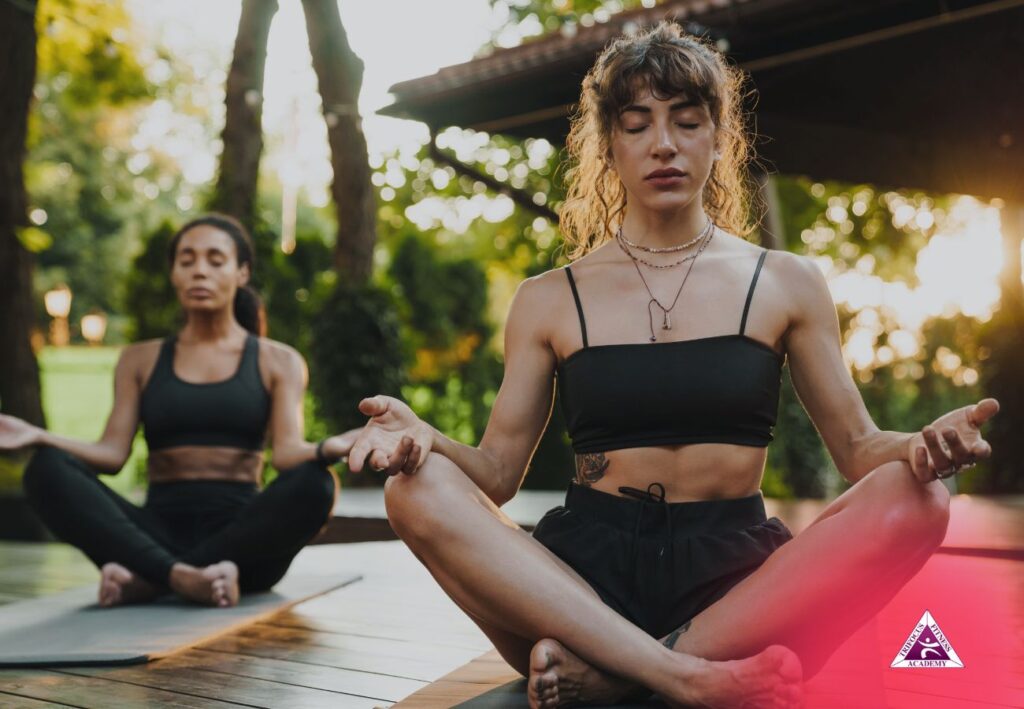
Yoga practice is so much more than just a physical regimen—it’s a system that encompasses physical, mental, spiritual and ethical or lifestyle aspects. Today’s yoga classes focus on posture and flexibility, but at their core, traditional yoga originates from ancient Indian philosophy. Dharma, Karma, and Bhakti are fundamental to this tradition. These aren’t simply abstract notions; they’re principles that guide how practitioners live, think, and navigate the world, both on and off the mat. Every movement, every breath, is not simply a means to build strength or cope with stress.
It is an act of alignment with truth (Dharma), with consequences (Karma) and with devotion (Bhakti). These concepts create clarity in life and enhance the intention behind all your yoga practices. Your dharma is your duty or path in life. Karma is the result of actions and the consequences of those actions. Bhakti is the way of love and devotion. The trinity of these principles serves as a powerful guide for living life with integrity, consciousness, and compassion. In the realm of yoga practice, they provide an explanation and context that imbues even the most mundane poses with a greater sense of meaning and accomplishment – they are part of a journey toward self-actualisation.
Dharma: Finding Purpose in Your Yoga Exercise Practice
In the yoga world, Dharma is more than physical alignment; it’s alignment with your higher purpose. The term “Dharma,” in Sanskrit, stands for duty, path, or righteous living. In yoga, it’s this notion that we all have our dharma in life, a unique role and responsibility, and when we fulfil that, we experience inner peace.
When you roll out that yoga mat, it’s more than just moving your body; it’s practising discipline, dedication, and self-understanding. These are Dharma, expressions of Dharma. For others, yoga is a means to heal the body. For others, it’s a way to clear the mind or nourish the soul. Knowing your ‘why’ behind your practice is a crucial step towards aligning with your Dharma.
Practising Dharma in yoga exercise also means being honest about what you can and cannot do and listening to your body’s wisdom. Pushing past those limits is often mistaken for ambition but may instead be a sign of ignoring your true path. Yoga philosophy tells us that any pose or practice, especially one that addresses how you feel or what you need that day, is just as important as being able to complete a fancy or flashy asana.
In the outside world, Dharma happens beyond the mat. The patience you build in your practice can extend to the way you treat coworkers, family, and even strangers. The discipline you create becomes part of how you enact your personal and professional commitments. Dharma is here to remind you that you’re never just doing your yoga — you’re preparing yourself for life.
To practice yoga with Dharma in mind is to make every movement an act of purpose. You are not just stretching your muscles. You are expanding your awareness to encompass the life you desire, the life you deserve.
Karma: Conscious Action Through Yoga Exercise
Among the followers of Indian philosophy, karma is one of the most famous concepts, unfortunately, often misinterpreted as destiny. Karma translates to action, or more directly, the law of cause and effect. For every action, there is a reaction, and this concept applies to the theory of yoga exercise.
When you practice yoga, you mould your Karma. Every inhale, exhale, posture, and decision you make on the mat reflects your internal being and has an impact on your external outcomes. Yoga, after all, is nothing if not the most advanced teaching on how mindful action can and should lead to clarity and balance, rather than being ruled by ego or impulse.
For instance, a physical injury from a yoga class done impatiently or competitively could be considered negative Karma for one moment of unaware action. On the other hand, when you practice with intention, listen to your body, and make your practice an offering, you can cultivate good Karma that enhances both physical and mental well-being.
Karma also promotes consistency in your yoga practice schedule. Skip practice because you’re too lazy or too distracted, and there’s a ripple effect—not just in your flexibility or strength, but in your discipline, your concentration, your self-respect. The daily yoga practice will give you the opportunity of ‘Hitting the Reset Button’ each day, to GIVE yourself the chance to reprogram your own ‘Karma’ with your effort.
Karma is how you treat, how you talk, how you put out your energy. The kind of patience you develop through long holds, or the compassion you extend to yourself when you’re fatigued, translates directly into human behaviour in the rest of your life. Yoga practice, when performed as it was meant to be, is an exercise in creating good, conscious Karma.
Bhakti: The Heart-Centred Path of Yoga Exercise
Whereas Dharma is about duty and Karma is about mindful action, Bhakti injects heart and love into the equation. Bhakti signifies devotion — a relinquishing of the self and a bonding to something larger than oneself. In Yoga, Bhakti is the heart of the practice.
Bhakti transforms yoga from a purely physical discipline into a sacred and spiritual practice. It asks practitioners not only to move with form, but also with feeling. Whether you’re sitting in stillness or moving through dynamic poses, Bhakti gives heart to your effort. It’s what elevates yoga from routine to reverence.
For others, Bhakti is offering each practice to a friend, teacher, or a higher power. For some, it’s about nurturing self-love and compassion. The key is intention. Bhakti-based yoga practice is less of a pursuit or a goal, and more of a submission, a releasing or even a consumption, a relinquishment of results and a savouring of the practice itself.
Bhakti is also essential in collective yoga practices. When you have a room full of people moving and breathing together, there’s a collective vibe that words can’t describe. This is what Bhakti in action, this feeling of collective devotion, and it’s a reminder that yoga connects us not only to ourselves, but with one another.
You don’t have to repeat mantras or practice a religion to access Bhakti. It could be something as simple as inviting gratitude onto your mat or regarding your breath as a gift. With Bhakti, we draw ourselves so deeply into the experience of yoga that it becomes an act of relationship, a reminder that we are part of something holy.
Integrating Philosophy into Your Daily Yoga Exercise Routine
Philosophy can seem abstract, but in yoga practice, philosophy is to be lived. Dharma, Karma, and Bhakti are not merely concepts—they’re instruments for taking your everyday practice deeper and giving meaning to your movements.
Start with awareness. Ask yourself this: Why am I practising today? Am I living into my Dharma — my place, my truth? Am I doing this intentionally to generate some good Karma? By Bhakti, am I expressing devotion? These questions transform practising yoga from a habit to a conscious ritual.
Why not tap back into these principles with a bit of breath work (pranayama) and meditation? Inhale Dharma, exhale Karma, and feel the Bhakti. These moments of contemplation can turn even a brief practice into an illuminating experience.
Journaling before or after yoga. As mentioned, the mindfulness of yoga helps me to maintain focus while journaling. Think about what your choices in practice have to do with your life.” Did you respect your boundaries today? Was your self-compassion in action? Writing connects your physical motion to your philosophical understanding.
Adjust your practice to meet your specific needs. If you’re feeling emotionally drained, embrace Bhakti in a gentler, heart-opening flow. If you’re feeling aimless, reach for Dharma by choosing an intention. If you’ve been reactive or scattered, attend to Karma through slow and deliberate movements.
Remember that yoga practice isn’t just about being better on the mat—it’s about being better in life. If you can embody these profound ideas while creating shapes and breathing, then with each practice, you become not just stronger and more flexible, but also wiser, kinder, and more connected.
Conclusion
Yoga is frequently viewed as a fad focusing on fitness, flexibility, or stress relief, but this practice has deep roots. The age-old concepts of Dharma, Karma, and Bhakti provide a firm foundation for a more enriching and value-added practice. They stand as a reminder that yoga isn’t only about what we do with our bodies, but also about the ways we shape our character and steer our lives.
Dharma encourages us to act deliberately, so that our actions are in line with our authentic path. Karma offers us the message that everything we put out will come back, and that being present is vital in every moment. It is an invitation to bring love and devotion into our work—to see the beauty inherent in our work and to let our effort be an offering. When these concepts are incorporated into our daily yoga practice, it is transformed from a mere repetition to a profound revelation.
Contact Trifocus Fitness Academy
Explore the rewarding path of becoming a certified Yoga instructor. Unleash your potential and inspire others on your journey with Trifocus Fitness Academy’s comprehensive Yoga program.

Frequently Asked Questions
Yoga practice involves applying purposeful structure and direction to your participation in yoga as part of your overall wellness journey, encompassing physical, mental, and spiritual aspects. It brings structure, a plan, aims, quotes, and philosophical sutras, such as Dharma, Karma, and Bhakti, to equip your yoga schedule with purpose and balance. Effective yoga exercise management will keep you consistent, adjust your exercises to your needs, and help you stay on track with your progress. Whether you’re new to yoga or well-practised, orchestrating your yoga practice is a way to deepen its effects and weave it more consciously through your daily life.
Dharma (life purpose) provides a reference point to guide yoga exercise management, helping you coordinate your practice with your life’s values and responsibilities. It’s all about practising the yoga that fits your life right now, from what your physical body can achieve to the emotional support you may need. Regarding your yoga practice, the lens of Dharma will keep you from simply chasing fads or harming your body or spirit, but rather respecting the unique path you are on.
Karma is a law of choice and consequence that is essential to the practice of yoga. Every decision you make — whether to play or not play, to grind or tap the brakes, accelerate or decelerate. Through the lens of Karma, you bring more consciousness to the kind of yoga you practice, the posture you choose, the breathwork, and the energy you use. It is an approach that promotes consistency, discipline, and self-awareness. Over time, it will cultivate a practice that helps you not only improve your physical strength but also has a positive knock-on effect on your thoughts, daily behaviour, and interactions.
Bhakti adds a more emotional dimension to yoga workout management, cultivating love, gratitude, and dedication directly within your practice. It redirects your attention from performance to presence. Whether it’s a practice dedicated to a loved one or dedicating every asana with love, Bhakti can elevate the practice to its core. Practising your yoga with Bhakti means respecting how you feel, being kind to yourself, and allowing room for a spiritual connection. It keeps your yoga alive, even when motivation wanes or things fall apart.
The key to the success of a yoga exercise program is consistency. A good habit develops the physique, purifies the mind, and enlivens spiritual consciousness. Without consistency, there is little hope of tracking your progress, cultivating self-discipline, or incorporating the philosophical aspects of yoga, such as Dharma, Karma, and Bhakti. It requires good management, realistic goals, some scheduling, and the willingness to adjust to stay in it. Small, just-for-today sessions are also a vehicle for lasting change.
A balance of structure and flexibility is what works for managing your yoga practice. While structure provides discipline and momentum, flexibility allows for white space and adjustment. You can schedule a weekly session with built-in choices for different levels of energy — make it dynamic on days when you have a lot of pep, and restorative on days when you are running on empty. Add Dharma by respecting your life needs, Karma through conscious decision-making, and Bhakti by introducing compassion into your day-to-day life. This approach will keep your practice sustainable, alive, and fresh, ensuring it continues to serve your needs instead of becoming just another obligation.