
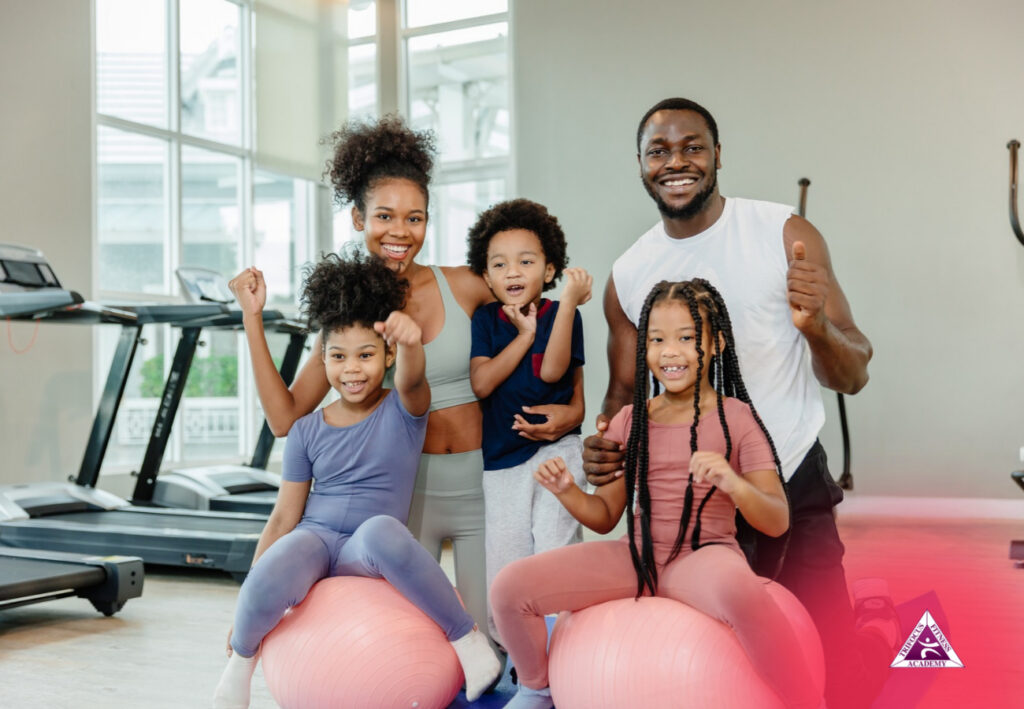
Exercise programmes that allow family participation can make fitness more accessible for families who want to be active. Parents and caregivers may have limited time, childcare obligations, varying fitness levels, or hectic schedules. Well-designed group exercise programmes can address these issues by offering structured sessions where adults and children can participate in age-appropriate ways.
Family classes take more preparation than just letting kids join an adult fitness class. Resistance or intensity levels may need to be higher to challenge children or adults, depending on their physical, developmental, and attention needs. Instructors need to plan activities based on a shared theme, but that involve participants in different approaches to the same task. Exercise benefits all ages. The World Health Organisation recommends 60 minutes or more of moderate-to-vigorous physical activity daily for children and adolescents ages 5-17, 150-300 minutes of moderate-intensity aerobic activity per week, and muscle-strengthening activity for adults.
Design Activities Around Age and Developmental Ability
The most critical concept of family Group Exercise is that children are not mini adults. As they grow, their movement skills, coordination, physical development, attention and knowledge of directions vary significantly. For a family session, it is therefore important to meet the needs of the youngest members when choosing movements and explaining activities. Games, brief activity time, short instructions, imaginative movements, and a variety of changing focus may be more attractive to younger children.
Older children and teens may benefit from more structured exercise activities and may also appreciate variety and skill challenges. Public health guidelines suggest that children engage in a variety of enjoyable, age-appropriate activities. Children ages 3-5 should be active throughout the day, and children ages 6-17 should aim for at least 60 minutes of moderate-to-vigorous activity daily.
The ACSM guidelines also stress that youth programs should acknowledge differences, offer diverse activities, build on fun and self-improvement, and not be based on adult conditioning programs for “little adults.” A family circuit may then have adults complete controlled SQUATS with resistance, while children do bodyweight SQUATS or a play sit-to-stand activity. Adults may follow a set interval for cardiovascular activity while children move from cone to cone, mimic animals, or follow a short movement activity.
Create Inclusive Sessions That Keep the Whole Family Engaged
A family fitness class should be structured enough to keep it organised and fun. Group Exercise instructors will need to balance instruction time with activities that promote movement, interaction, and shared participation. A good strategy is to structure sessions into short activity units instead of long, repetitive activities. Simple follow-the-leaders, walking, light skipping, arm movements or mobility activities can form part of a warm-up. The bulk of the class can then move on to circuits, partner challenges, less competitive relay-type activities, movement games, or simple strength and coordination activities.
Variety, especially when children are involved, helps because attention can wane during prolonged, repetitive movement. The CDC recommends making activity fun and introducing children to a variety of movement, such as walking, running, cycling, swimming, playing in a recreational environment, and any activity they enjoy. Adults also need a suitable exercise experience. An instructor can offer choices so caregivers can add resistance, range of motion, duration, or intensity while children complete simpler options.
Partner-based activities can also promote family interaction. Parents and children may toss a light ball, mirror each other’s movements, walk through a course together, or rotate through simple activity stations. The programme needs to be accessible to all abilities. The children will not have the same experience in terms of their coordination, confidence or movement, and some families may include a person with a disability or health issue. ACSM suggests that children be allowed to participate in youth activity in ways that address their unique abilities and needs, not in a uniform manner. An inclusive class will also not strongly emphasise weight, body appearance, or burning calories. Family sessions allow for positive reinforcement of exercise through movement, strength, energy, skill, enjoyment and active time together.
Prioritise Safety, Supervision and Appropriate Exercise Selection
Safety is particularly important when a group exercise programme includes participants of widely varying ages and abilities. The instructor must consider equipment, class size, supervision, exercise complexity, space, and the possibility of younger participants moving erratically. Check the activity area before the session. Equipment should be properly stabilised and suited to the people operating it, and space should be provided to limit collisions. ACSM also recommends regular inspection of activity areas, along with qualified supervision, appropriate footwear and clothing, and suitable movement instruction, as an important consideration in designing physical activity opportunities for children and adolescents.
Lists of exercises should also include exercises that are suitable for developmental ability. Children should not be given complex resistance exercises, loads that may be too heavy or too many repetitions without first consulting an appropriately qualified trainer. Bodyweight movement, climbing, jumping, running, balancing, throwing, catching, or playful activities may also suit younger participants and help develop physical skills. CDC advises that children usually develop strength naturally by participating in activities like climbing and gymnastics, without a formal program designed for adults.
Provide clear rules and start activities. Participants should be aware of their own location and when and how activities should begin and end, as well as when equipment can be used. Supervision should also be adequate to the class setting. One teacher should not try to oversee too many people or age groups to keep them safe. For younger children, parents/carers should be actively involved where necessary, according to the facility’s policies, and not be seen as providing unsupervised childcare during the session.
Encourage Family Habits That Continue Beyond the Class
A whole-family fitness programme that encourages exercise outside the programme can be more valuable. Group Exercise teachers can help families understand that exercise doesn’t always require a formal session or special equipment. Being physically active with friends, biking, playing active games, visiting parks, playing sport, dancing, or doing simple movement activities at home can all help build a more active lifestyle.
Family involvement can be especially helpful, as adults can shape children’s attitudes toward physical activity. The CDC recommends that families make movement part of daily life and that adults set an example by participating themselves. An instructor can support this idea with simple activity ideas that families can do easily between lessons. This should not be time-consuming homework programmes. The point is to make movement feel possible.
For instance, families could be asked to go for a short evening walk, pick a weekend active activity, make a basic movement game, or spend some family recreational time outdoors. Families can also find activities they enjoy in the class. Some children might be especially interested in dance movements, others in running games, and others in balance or strength activities. Parents can also find other exercise options that they hadn’t thought of before. This variety matters because people are more likely to participate in activities they enjoy. Effort should also be rewarded appropriately. Children may find their coordination improves, adults may find they have more endurance, and after a few weeks, some activities might be easier for everyone.
Conclusion
Group Exercise programmes for the whole family are not just “children’s programmes” with adults added on; to be effective, they must be properly designed and implemented. Developmental requirements, physical abilities, attention spans, and activity levels vary by age. Programming should therefore be set up as a shared experience, with each participant working at an appropriate intensity. Keep the exercise appropriate for the child’s age. Children should do a variety of fun, enjoyable physical activities, and adults should do aerobic and strength activities.
Contact the Trifocus Fitness Academy
The Trifocus Fitness Academy offers specialised online and internationally accredited Group Exercise courses that have been designed to outfit professionals with all of the skills and knowledge needed to find success as a professional Group Exercise Specialist.

Frequently Asked Questions
Group Exercise can be modified by providing age-appropriate movements, adjusting exercise intensity, shortening exercise blocks, giving simple instructions, and allowing adults and children to participate together at appropriate levels.
Children’s developmental, coordination, strength, and attention needs differ from adults’. Age-appropriate exercises make exercise safer, more fun and better suited to their physical abilities and stage of development.
Group Exercise instructors can use a variety of exercises, relays, simple challenges, partner activities, movement games, and circuits to keep people engaged and involve different parts of the family at an appropriate level.
Instructors should consider supervision, equipment, class size, movement complexity, available space, age differences, and clear safety instructions. Instructors should also adjust exercises based on participants’ ability and experience.
Group Exercise can introduce families to fun activities they can do at home, such as walking, cycling, dancing, active games, outdoor activities, and simple movement challenges they can incorporate into daily life.
Not necessarily. Family programmes tend to be more inclusive when they focus on participation, enjoyment, movement competence, confidence, and personal achievement rather than comparing the performance of adults, children, or families.