
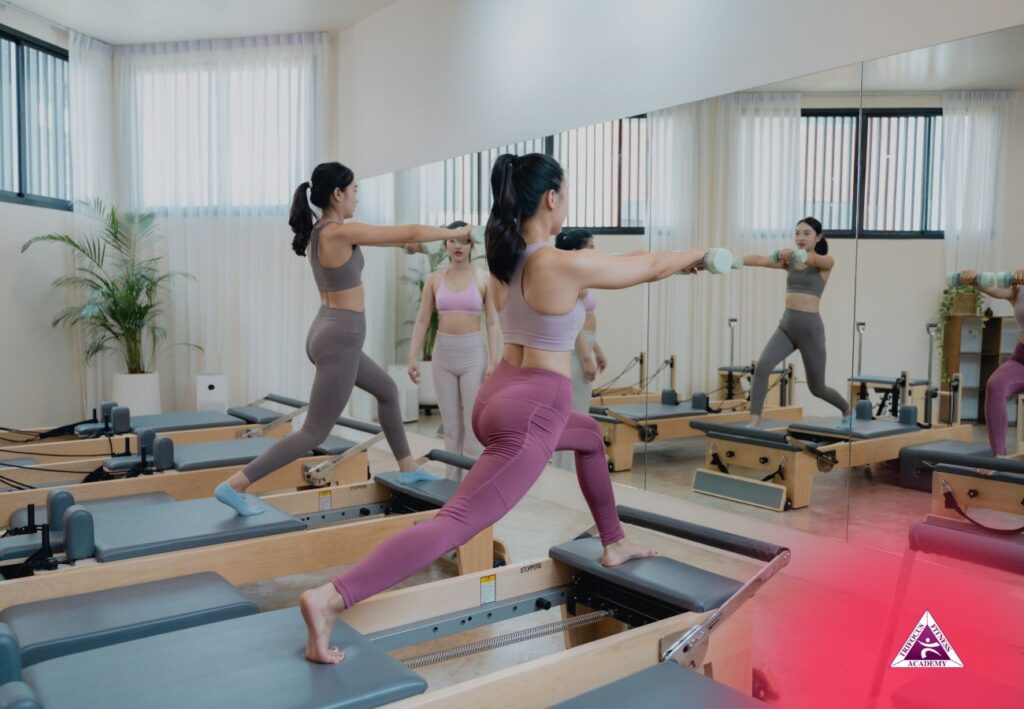
All athletes in every sport seek ways to enhance performance, prevent injuries, and prolong the longevity of their training. Cross-training – the inclusion of forms of exercise that differ from an athlete’s primary sport – is one of the most successful methods of achieving these aims. Cross-training. There are several ways to cross-train, and among these methods, Pilates exercise is one of the most beneficial tools for an athlete to incorporate into their fitness plan.
Pilates is a workout that focuses on gaining strength, improving flexibility, and developing control and endurance throughout the entire body. It’s the difference between a typical strength or endurance workout and Pilates exercise, which targets the body’s centre of power, restores alignment, corrects imbalances, and centres you for better overall movement – all necessary for a committed athlete in pursuit of longevity and peak performance.
Core Strength and Stability: The Foundation of Athletic Performance
Core stability and strength have always been important in any sport, not just surfing. The core isn’t only those muscles that look like a six-pack — it also includes deep stabilisers such as the transverse abdominis (TVA), multifidus, pelvic floor and diaphragm, which work as a team to support the stability of the spine and pelvis.
When these muscles are firing on all cylinders, athletes are better able to generate force and express power. They are more able to maintain the correct form and avoid compensating in ways that lead to injuries.
Pilates exercises precisely target these deep core muscles. Movements such as the ‘Hundred’, plank variations, roll-up and teaser build an athlete’s overall core stability to provide precise control and allow effective static and dynamic performance. For instance, a sprinter can have the core strength and stability to maintain their posture correctly when accelerating, and a golfer can generate power from rotation without compromising the low back.
Pilates instruction instructs athletes to engage their core before moving, helping to ensure the body is properly prepared for influential movements and efficient energy transfer. The concept of “proximal stability for distal mobility” refers to the ability of strength and power generated in the legs or arms to be transmitted more effectively up the kinetic chain to the next body part, resulting in improved athleticism and reduced energy loss.
Flexibility and Joint Mobility: Expanding Athletic Range of Motion
Most athletes regularly struggle with tight, stiff muscles and limited joint mobility due to performing the same movements repeatedly throughout their sport. For instance, runners often have tight hip flexors, while swimmers may feel tightness in their shoulders, and a weightlifter may lack thoracic spine mobility. If left unaddressed for extended periods, these limitations can impair performance and increase the likelihood of overuse injuries.
Pilates workouts focus on mobility and flexibility by moving joints through their entire range of motion, while also providing resistance to engage the muscles. In contrast to passive stretching, the Pilates training method combines flexibility with strength, allowing athletes to develop flexibility without sacrificing control due to a lack of strength.
Series like “Spine Stretch Forward,” “Saw,” “Cat-Cow,” and “Open Leg Rocker” contribute to opening the spinal articulations. Workouts like leg circles, bridging, and side-lying leg work help your hips develop their strength and control. Open up the shoulder through Pilates exercises such as “Arm Circles,” “Swimming,” and scapular stabilisation exercises.
This balanced freedom to move and run allows for more free movement, longer strides, greater power, and fewer compensatory patterns, thereby reducing the risk of strain or injury in the athlete. Pilates helps to free up stuck joints and teaches athletes how to control those newfound ranges of motion.” Balancing the body is incredibly useful for understanding how to move effectively within your sport and can also help improve performance.
Correcting Muscle Imbalances and Promoting Symmetry
Many sports naturally cause muscular imbalances. Take tennis players, for instance – one-sided dominance is often the result. If left uncorrected, these imbalances can lead to poor movement, compensation, and long-term injury.
Pilates exercise is an excellent modality for detecting and rectifying these imbalances, as Pilates is based on unilateral movement, body awareness, and proper alignment. Exercises such as the “Single-Leg Stretch,” “Side Kick Series”, and “Leg Pull Front” work one side of the body at a time, making unevenness between strength and flexibility more apparent, but sooner.
Working to pattern and cue carefully, Pilates exercises provide athletes with the opportunity to strengthen weaker muscles and restore side-to-side symmetry to their bodies.
Pilates exercises promote awareness and mindful movement, helping athletes gain better proprioception about how their body works in space. It allows the athletes to develop an “awareness” of their body and increase their muscle balance by learning how to correct their movements, so that their muscles are prepared to fire in the correct sequence during sport-specific tasks.
Through Pilates exercises, athletes can focus on muscle imbalances that can lead to chronic injury, thereby leaving the body more balanced and injury-resistant through consistent training.
Rebalancing the body’s muscles through Pilates exercises enhances movement efficiency, increases power, and enables athletes to challenge themselves at a more intense level with reduced joint wear and tear.
Movement Efficiency and Injury Prevention: The Long-Term Athletic Advantage
Elite athleticism is all about doing things the best way they can be done. The better an athlete moves, the less energy is wasted, the quicker the recovery time, and the lower the risk of injury. Pilates Training is instrumental in developing movement efficiency through improved body alignment, enhanced neuromuscular coordination, and effective sequencing.
Each Pilates move is a disciplined, purposeful movement to help free the proper mechanics. For instance, exercises such as “Rolling Like a Ball,” “Toe Taps”, and “Control Balance” demand full-body coordination, training athletes to activate the core, stabilise the spine and move the limbs without compensation. Those neuromuscular gains then translate to sport-specific movements, such as running, jumping, swinging, and cutting.
Additionally, injury prevention is a significant benefit of Pilates exercises. Much of it is due to improper movement patterns, a lack of joint stability, or even muscle imbalances that develop over time. By focusing on stabilisers, increasing flexibility, and improving alignment, Pilates training allows athletes to move through their full range of motion while reducing unnecessary strain. This, in addition to lowering the risk of acute injury, also serves as a preventive measure against overuse injuries that can develop over the season.
Pilates training can be an excellent active form of rehabilitation for athletes working through prior injuries. This low-stress, controlled setting allows you to gradually strengthen and retrain the injured region while improving your overall movement quality.
Conclusion
In the world of sports, cost is of the essence. Pilates cross-trains the athlete in a way that no other workout can. Pilates exercise differs from most common training, which is limited to strength, speed, and endurance; instead, it focuses on enhancing fundamental movement mechanics that underpin all activity.
Pilates exercises develop the deep core muscles, joint mobility, muscular balance, and movement coordination that allow you to move in a more controlled, powerful, and precise manner for your sport. No matter how fast you’re running, however many laps you’re swimming, how hard you’re hitting a ball, or how you’re training for an endurance event, Pilates workouts condition your body for durability, flexibility, and fitness so that you can excel.
Contact Trifocus Fitness Academy
Explore the rewarding path of becoming a certified Pilates Instructor. Unleash your potential and inspire others on your journey with Trifocus Fitness Academy’s comprehensive Pilates Instructor program.

Frequently Asked Questions
Benefits of Pilates for Cross Training can very effectively support athletic cross-training through greater core stability, flexibility, balance, and articulate, economical movement. And unlike many traditional fitness regimens, Pilates exercise focuses on deep stabilising muscles for maintaining proper alignment and control of the joints. This allows athletes to translate force more efficiently during sport-specific limb movements and minimise the potential for injury due to inefficient repeatability in neck core mechanics.
Yes, Pilates workouts are very effective in preventing sports injuries. It strengthens the stabiliser muscles, can increase joint mobility, and corrects muscle imbalances—the type that can lead to injuries in athletes. Many injuries occur due to poor movement patterns or weakness, which Pilates exercises correct through precise, controlled movements. Pilates is great for athletes because it improves body awareness, posture, and alignment, which in turn allows for less stress on joints and muscles when performing very rigorous activities.
Absolutely! From professional athletes to novice exercisers, workout enthusiasts can reap the benefits of Pilates. Whether you’re a runner, swimmer, cyclist, or play team sports, Pilates exercises can be tailored to meet your individual needs. Given that it is low-impact and adjustable, it is excellent for developing core strength, protecting and increasing flexibility, and joint stabilisation, without straining the body. Pilates can be tailored to an athlete’s level, injury history, and sport performance goals, making it adaptable to improve sports performance and decrease the risk of injury for all athletes.
Some athletes try to do 2-3 Pilates workouts a week for cross-training purposes. Which frequency allows for maintaining a high level of core stability, flexibility, and control over movement, and fosters highly effective core muscles with minimal interference with training for primary sports. Pilates exercise is also beneficial for recovery days, focusing on muscle balance and joint stabilisation, which results in decreased fatigue. Through consistent practice, Pilates improves performance by targeting the athletes’ least utilised muscle groups, dysfunctional movement patterns, and reinforcing functional ones, which ultimately lead to better sport-specific skills and a reduced risk of injury.
Yes, Pilates training is excellent for recovery, both for athletes and for individuals recovering from injuries. It’s controlled; low-impact pressure allows athletes to restore strength and stability without overworking their healing tissues. Pilates-based exercise can be used to re-educate neuromuscular coordinative mechanisms, increase joint mobility, and activate muscles weakened by injury. Several rehabilitation programs developed by physical therapists specifically incorporate Pilates exercises, as they focus on both movement quality and strength.
Pilates also enhances performance through core reinforcement, joint mobility, and biomechanical efficiency. Each Pilates movement is designed to stabilise the trunk and allow for controlled movement of the extremities, which correlates to improved balance and power in sport-specific movements. Balance, flexibility, and body awareness —all things that help athletes move more efficiently and with better control —are enhanced. Pilates exercises correct imbalances and perfect alignment, enabling athletes to perform at their peak while reducing the risk of injury and speeding recovery.