
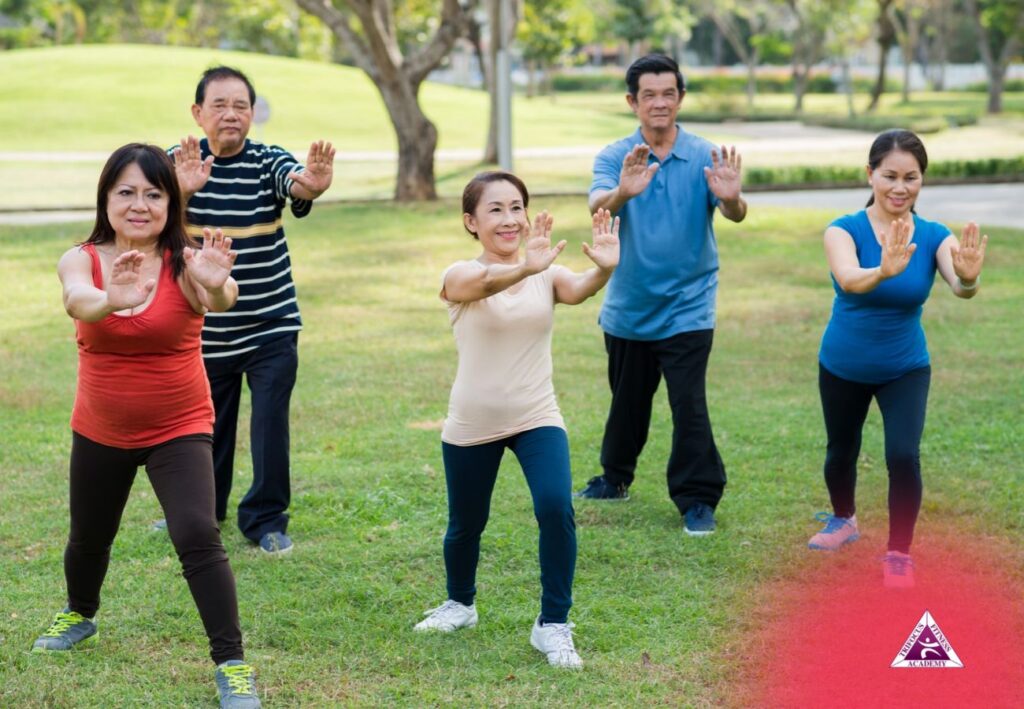
Tai Chi is a relatively simple mind-body exercise involving slow, controlled movements, breathing, concentration, balance, and posture awareness. These features may make it especially beneficial for special populations’ wellness programmes, where exercise may need to be modified based on mobility, physical capacity, health factors, and personal confidence.
Certain chronic health conditions, people who need more supervision and modification of their exercise, older adults, and those with limited mobility are examples of special populations. No single programme or movement level suits all special populations, so avoid making such assumptions. Tai Chi movements can be modified in several ways, such as simplifying, using a smaller range of motion, slowing the movements, or practising seated. This may enable participants from diverse backgrounds to stay active without high-impact activities or complex equipment.
Improving Balance and Stability in Special Populations
Balance should be an important consideration when working with special populations, such as older adults or individuals with decreased mobility and/or increased fall risk. Many Tai Chi movements require people to shift weight, change direction, step in coordination with their weight, and keep their body upright, which may help. Participants are not encouraged to slide quickly from one position to another, but rather to move weight slowly and keep their centre of gravity in mind. This can provide further practice in a safe context.
These results are of particular interest to a diverse population of participants for many everyday activities, such as getting up from a chair, walking, turning, or changing direction. Instructors should still consider each student’s fall risk, strength, medical history, and mobility. Some participants may need longer movement sequences, wider stances, and/or support from suitably trained healthcare and/or rehabilitation professionals. Tai Chi can therefore support balance training for diverse populations, but the same programme cannot be used without modification.
Providing Adaptable Movement for Special Populations Exercise
The difficulty in designing exercise for special populations is modifying activities to achieve meaningful participation. Tai Chi can help with this, as the speed, range, stance, duration and complexity of movements can often be varied. For a participant who has difficulty with deep knee bending, they could move in a more upright position with a smaller range. If their attention is easily lost, they can try shorter series of movements, easing them in and out with breaks in between. For those who cannot stand, some movements can be modified to be done seated.
This flexibility can help develop a more inclusive, diverse programme. Participants can participate meaningfully even if they cannot do all the moves at the same level. Another possible benefit is that Tai Chi requires no jumping, sprinting, or quick changes of direction. This can make it more accessible for those people who might be less prepared to attend a traditional high-impact fitness class. Effortless and suitable for all are not synonymous with gentle. Even with a special population, fatigue, instability, joint discomfort, dizziness or trouble maintaining specific positions can occur. Thus, the instructor needs to check movement quality and ask participants to keep it within a suitable range.
Supporting Mental Wellbeing and Movement Confidence
Physical ability is only one consideration when designing a special populations wellness programme. Other factors such as confidence, stress, fear of movement, and previous exercise experiences may also affect whether someone feels comfortable exercising. This area of wellness may be promoted with Tai Chi for this reason: sessions tend to focus on slower movements, breathing, awareness, and gentle progression rather than competition and speed. Participants from diverse backgrounds might feel more comfortable in a slower environment. Someone concerned about losing balance, struggling to keep up, or making movements incorrectly may find it easier to practise deliberately over time.
The mental focus that comes with Tai Chi may also help participants focus more on posture, breath, footwork, and body reactions in their practice. This awareness can increase participants’ confidence in their movement skills over time. In a diverse population context, group participation may benefit the individual. Classes can provide chances for interaction, routine and shared activity without competition between individuals. The instructor can support this by giving clear instructions, letting participants work at their own pace, and refraining from comparing participants.
Maintaining Safety in Special Populations Tai Chi Programmes
Safety should always be at heart when introducing Tai Chi to a special population. Tai Chi is generally performed in a slow, low-impact manner, but that doesn’t mean every movement is appropriate for all participants. Before taking part, teachers should know relevant health information, any movement restrictions, any prior exercise history, and any advice from health professionals. Individuals who have severe balance issues, injuries, cardiac issues, neurological disease or other medical issues may need further assessment or specific assistance.
Fitness professionals should then consider individual ability when modifying movements. A diverse-population participant may require a shortened range of motion, stable support nearby, slower transitions, shorter sessions, seated options, or extra recovery periods. Fitness professionals also need to stay in their lane. They should not diagnose medical conditions, suggest they can alter prescribed medication, or claim that Tai Chi can cure or prevent a disease.
If a diverse population participant develops a complaint, dizziness, sudden weakness, severe pain, unusual shortness of breath, or other symptoms, they should discontinue activity and seek professional advice. Continued observation is also necessary to provide effective instruction for special populations. Ability may vary from one session to the next due to fatigue, medication, disease, stress, and/or changes in mobility.
Conclusion
Using tai chi as an adaptable movement modality in a special populations wellness programme can be beneficial. It has a slow pace, controlled movements and weight transfers, breathing exercises, and posture exercises, all of which allow flexibility in participation across a wide range of abilities. One area of research that has demonstrated particularly positive outcomes is balance. Recent reviews of older adults show that Tai Chi can improve balance performance and some fall-related outcomes, but exercise selection should always consider individual safety, capabilities, and needs.
Contact the Trifocus Fitness Academy
The Trifocus Fitness Academy offers a specialised online and internationally accredited Exercise and Special Populations Course designed to equip professionals with all the skills and knowledge needed to succeed as a professional Personal Trainer.

Frequently Asked Questions
Tai Chi can offer gentle, flexible movements to support balance, coordination, posture, and body awareness. Exercises can be adapted for mobility, confidence, physical capacity, and individual health.
Many older adults can benefit from Tai Chi because the movements are slow and controlled. Modifications may be necessary based on balance, strength, mobility, medical history and exercise history.
Tai Chi exercises involve controlled weight shifts, postural awareness, coordinated stepping, and slow changes in direction. These movement patterns allow participants to practise balance and stability in a structured environment.
Yes. Movement may be restricted, performed at a slower pace, simplified, supported or adapted to seated practice as appropriate. All changes should relate to the individual’s ability and safety needs.
Consider health history, mobility, balance, exercise tolerance, and professional recommendations when determining appropriate instruction. If the pain, dizziness, chest discomfort, unusual breathlessness or other symptoms are severe, participants should seek medical advice.
No. Tai Chi can be used alongside a broader wellness or exercise program, but should not replace medical treatment, physiotherapy, rehabilitation, or other professional health care advice when deemed necessary.